Tuesday, February 7, 2012

Chapter 4: Organization

Spatial Relationships: 

Space Within a Space
When a space is completely contained within the volume of a larger space.
This Cinderella carriage standing in the middle of this bedroom creates a separate space within the room. It makes the bed inside into it's own area for sleeping, keeping it semi-private from the rest of the room.


Adjacent Spaces
Two spaces right next to each other with space in between or sharing a border.
This living room and dining room are adjacent or next to each other. They are divided by a partial wall that forms a border between them.


Spaces Linked by a Common Space:
Two separate spaces connected by a a third middle space.
The bathroom shared between these two bedrooms is the common space that links them together. They are separate private spaces sharing a third space in the middle.


Spatial Organizations:

Centralized Organization
Dominant space surrounded by a number of secondary spaces.
On this old southern plantation, all of the outbuildings are centered around the main large house. Barns, living quarters, storage, and other things were all kept in separate buildings.


Linear Organization
Spaces repeating in a line formation.
These horse stalls are set up one after another in a long line down the side of the barn. This is the easiest way to make use of space and keep the horses organized and in their place.

Tuesday, January 31, 2012

Chapter 3: Form & Space

Form & Space: The Unity of Opposites
Describes how people visually perceive positive (figures) and negative (background) elements.
The building is the positive space and the courtyard is the negative space. The building encloses a portion of its site as an outdoor area, partly sheltered. The positive and negative space cannot exist without each other.


Defining Space with Horizontal Elements: Overhead Plane
Any form placed in a space changes the volume of the space and claims its own territory.
This covered porch uses an overhead plane to create shelter while remaining an outdoor space. The columns help to visually establish the limits of the defined space without disrupting the flow. You can easily travel between the columns and they do not obstruct from the view.


Defining Space with Vertical Linear Elements: Single Vertical Elements
Describes how the visual limits are effected by vertical boundaries.
The columns that hold up the roof over this outdoor shelter help define the space. There are no walls, but there is a boundary created by the vertical posts.


 Qualities of Architectural Space: Degree of Closure
Four vertical planes are typically used to encompass a field of space. One or more can be differentiated.
This kitchen is partially enclosed with a wall that has openings. The space definitely loses its sense of enclosure with the large opening in the wall. The emphasis is on the enclosing walls rather than the volume of the kitchen space as a whole.


Openings in Space-Defining Elements: Within Planes
Used to create continuity within adjacent spaces. 
 The windows openings on this plane create visual continuity with the view outside, while the door creates physical continuity with the outdoor space beyond. Continuity is not possible without these openings.

Monday, January 30, 2012

Chapter 2: Form

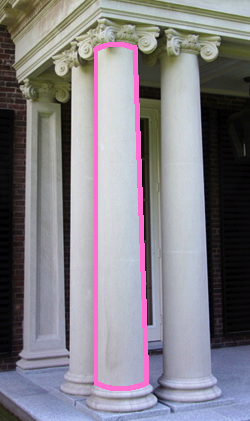
Primary Solid- Cylinder
The primary solids are spheres, cylinders, cones, pyramids, and cubes. They are the basic three-dimensional shapes. Cylinders have two circular faces and a round barrel.
These Georgian columns are a perfect example of a cylinder. They sit upright on one of their round faces and support the overhang with the other. The round part in between is what takes them from a rectangle to a cylinder.

 
Dimensional Transformation
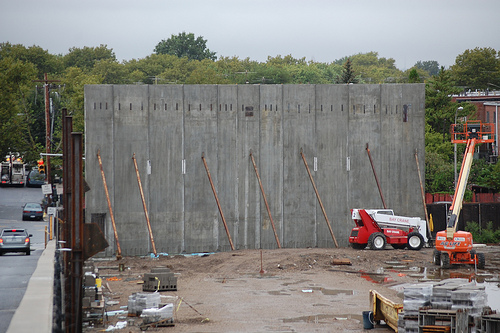
Any form can be transformed by altering one or more of it's dimensions while still maintaining it's identity as a form. A cube can be compressed into a plane.
This cement building is a cube in it's complete form. The solitary cement wall represents the cube compressed into it's planar form, but it is still a member of the cube family of forms.


Subtractive Forms:
When parts of a form are taken away, the form can either retain its identity in its original form family, or change so much that it joins a different family of forms.
The overhang on this barn is an example of a subtractive form. The interior of the cubic form is missing, creating just an outline of a form.


Additive Form- Linear
Made by attaching or relating one or more smaller forms onto the original form.
Town homes stacked next to each other are an example of additive forms arranged in a linear formation. The cube-like shaped homes are attached to one another on each side, making one long line.


Formal Collision of Geometry- Circle & Square
Two different forms join each other and penetrate each others boundaries.
This rendered garden is an example of one of the two forms totally receiving the other within its volume. The boundary of the garden is a square, with the inner path and plants in a circular form.


Wednesday, January 25, 2012

Chapter 1: Primary Elements

Point
A point indicates a certain place in space, a line, an intersection, or the center of something.
The blue point is set at the end of the tunnel as it appears to the human eye. This sidewalk covering tunnel was designed in a straight line so that people walking into it could see directly out the other side. Although point can be applied anywhere, this is a good example because from this perspective, the tunnel appears to end in a point.


Line
A line is a point that has been extended in a certain direction and length.
 Line is utilized repeatedly in both this house and the picket fence around it. I chose to focus on the repeated parallel lines in the fence for my diagram, but also pointed out the parallel lines on the siding of the house, the tin roof, and the detail on the overhang.


Plane
A plane is a flat surface created by two parallel lines. It can be solid like a wall,
or implied between two columns or posts.

A basic plane is represented by the wall that juts out containing the fireplace. It is easy to show the outlines of the plane in this example. Two sets of parallel lines outline and contain this vertical rectangular plane.
.

Volume
Volume is created when a plane is extended further to include a third dimension: depth.
The four places of these glass walls combine to make a voluminous room. Any room has volume, but this is a good example since you can see through to all of the sides and recognize the three dimensions of the space.
.